
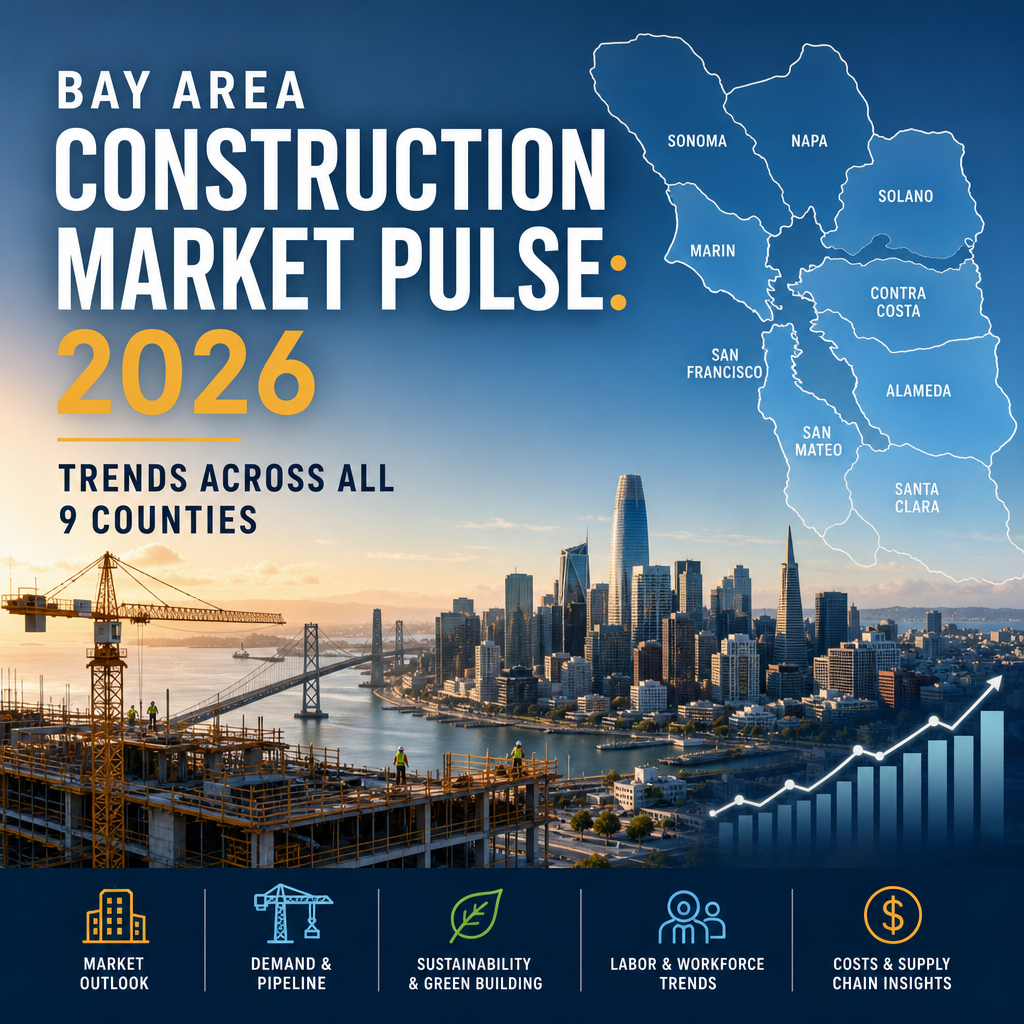
Bay Area Construction Market Pulse: 2026 Trends Across All 9 Counties
Bay Area Construction Market Pulse: What’s Driving 2026 Building Trends Across All 9 Counties
The Bay Area construction market is entering 2026 with a very different rhythm than it had just a few years ago. Instead of one dominant story, the region is being shaped by several overlapping forces: infrastructure investment, housing pressure, climate resilience, adaptive reuse, and a cautious but active commercial pipeline.
Across all nine counties, developers, public agencies, and contractors are responding to changing costs, tighter entitlements, and shifting demand. The result is a more selective market—but not a stagnant one.
A More Targeted Construction Cycle in 2026
In 2026, the Bay Area construction market is less about speculative expansion and more about strategic building. Projects moving forward tend to fall into a few clear categories:
- Housing with public or mixed-income support
- Transit and civic infrastructure
- Life science and healthcare upgrades
- Retrofits for energy, seismic, and fire resilience
- Industrial and logistics projects in key corridors
Higher borrowing costs have forced many private developers to rethink timelines. At the same time, state housing mandates, local capital improvement plans, and federal infrastructure funding are keeping construction activity alive.
This means the market is not slowing evenly. Some sectors are pausing, while others are accelerating.
Housing Still Leads the Conversation
Housing remains the biggest long-term driver across the region. Every county is under pressure to add units, but the type of housing moving forward in 2026 is changing.
What’s getting built
More projects now emphasize:
- Multifamily infill near transit
- Affordable and workforce housing
- Accessory dwelling units and small-lot development
- Mixed-use urban redevelopment
Luxury condo demand has cooled in some submarkets, but rental housing and public-private housing partnerships remain active. Cities are also pushing denser projects in underused commercial corridors, especially where office demand has softened.
For builders, that creates opportunity in mid-rise residential, podium construction, and phased community developments.
Office Is Soft, but Adaptive Reuse Is Rising
Office construction is no longer the defining force it once was in San Francisco, Silicon Valley, and parts of the Peninsula. Vacancy remains a major factor, and many landlords are investing in repositioning existing assets rather than breaking ground on new towers.
That shift is opening the door for adaptive reuse.
Older office buildings are being studied for:
- Residential conversion
- Life science repositioning
- Education and training uses
- Mixed-use redevelopment
Not every building pencils out for conversion, but the concept is shaping 2026 building trends in urban cores. Contractors with experience in renovation, code upgrades, and occupied-site work are likely to see stronger demand than those focused only on ground-up office.
Infrastructure and Climate Resilience Are Major Growth Areas
Public works are becoming one of the most dependable segments in the Bay Area construction market. Local governments are funding projects tied to mobility, utility modernization, and climate adaptation.
The biggest public-sector priorities
Expect continued activity in:
- Transit station improvements and rail-adjacent development
- Water and wastewater upgrades
- Road and bridge repair
- School modernization
- Flood control, shoreline protection, and wildfire hardening
Climate resilience is especially important in 2026. Sea level rise concerns are shaping construction around the shoreline, while wildfire risk is influencing materials, defensible design, and code compliance in North Bay and inland areas.
This is no longer a niche category. Resilience work is becoming a standard part of design and construction planning.
County-by-County Momentum Across the 9 Counties
While regional trends matter, each county has its own construction pulse.
San Francisco, San Mateo, and Santa Clara
These counties are still defined by a mix of housing demand, institutional projects, and selective commercial development. New office starts remain limited, but healthcare, lab space, transit-linked housing, and major retrofits continue to move forward.
Alameda and Contra Costa
East Bay growth is being driven by multifamily housing, infrastructure, logistics, and public-sector work. Transit corridors and suburban downtowns are seeing steady redevelopment interest, especially where land is more available than on the Peninsula.
Marin, Sonoma, Napa, and Solano
In the North Bay and Solano County, 2026 trends lean more heavily toward resilience, civic improvements, healthcare expansion, and lower-scale residential growth. Fire recovery, insurance-related rebuilding, and hardening existing structures remain important themes in parts of these counties.
Labor, Materials, and Delivery Strategies Are Still Shaping Deals
Construction demand may be selective, but execution remains challenging. Labor availability is still uneven, especially for skilled trades tied to mechanical systems, concrete, and electrical work.
Material costs have stabilized compared with recent volatility, but they have not returned to pre-pandemic norms. That is pushing owners and general contractors toward more disciplined project delivery strategies.
Common approaches in 2026
Many teams are relying on:
- Early contractor involvement
- Design-build or progressive delivery models
- Prefabrication and modular components
- Value engineering earlier in design
- Phased permitting and construction sequencing
These strategies help reduce risk in a market where margins remain tight and schedules are closely watched.
What to Watch for the Rest of 2026
The Bay Area construction market in 2026 is not being driven by a single boom. Instead, it is being sustained by necessity: housing production, infrastructure upgrades, code compliance, and climate adaptation.
That creates a market with real opportunity for firms that can navigate complexity.
The builders most likely to succeed are those that understand local approvals, shifting financing conditions, and the specific needs of each county. From infill housing in San Jose and Oakland to resilience work in Sonoma and shoreline planning in San Mateo, the region’s next chapter will be defined by practical, high-impact construction.
In short, 2026 building trends across all nine counties point to a Bay Area that is still building—just more carefully, more creatively, and with a sharper focus on long-term value.