
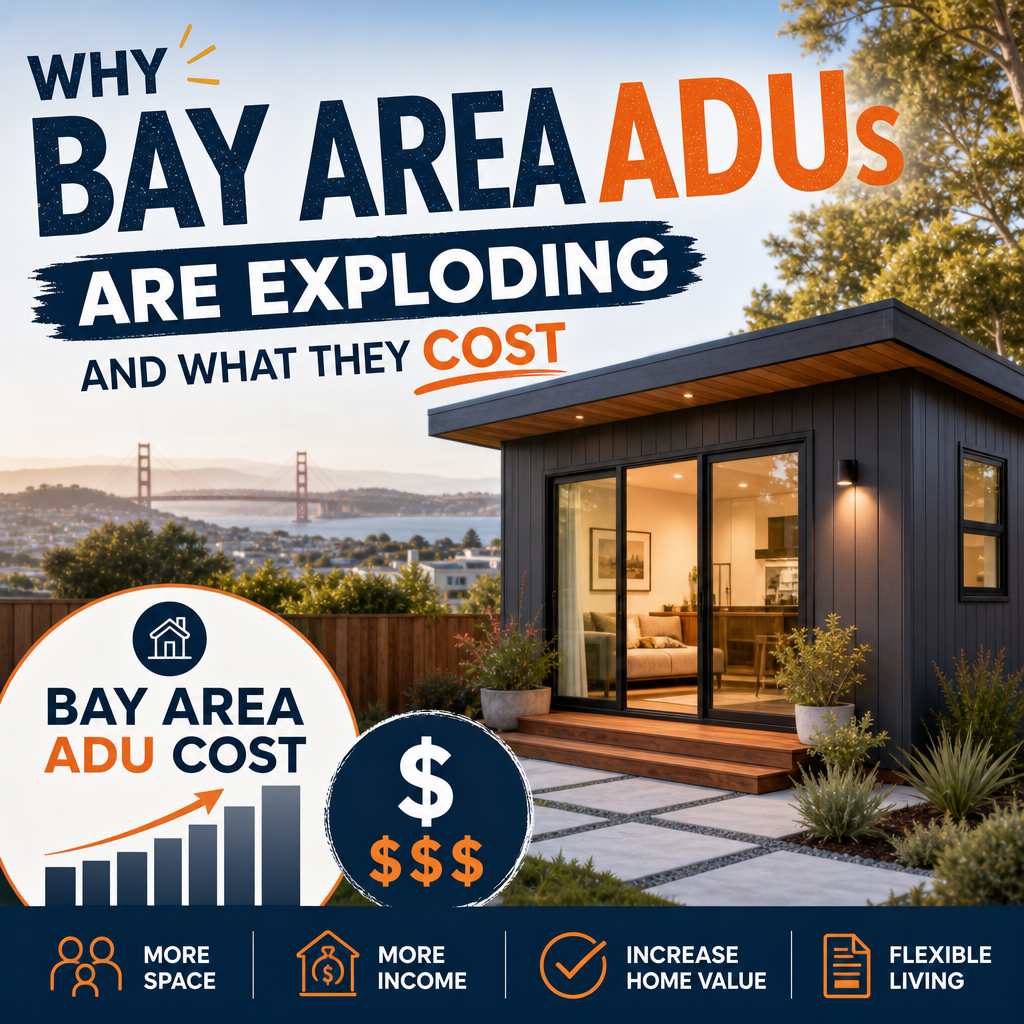
Why Bay Area ADUs Are Exploding and What They Cost
Why ADUs Are Exploding in the Bay Area — And How Much They Really Cost to Build
ADUs in the Bay Area have gone from niche backyard projects to one of the most talked-about housing solutions in California.
An accessory dwelling unit, or ADU, is a smaller home built on the same lot as a primary house. It can be a converted garage, a basement apartment, an attached addition, or a standalone backyard cottage.
So why are so many homeowners building them now?
The short answer: the Bay Area’s housing crisis, changing family needs, and new state laws have made ADUs far more practical than they used to be. But the other big question is the one homeowners care about most: how much do ADUs in the Bay Area really cost to build?
Why ADUs Are Booming in the Bay Area
1. Housing is expensive, and ADUs create flexible space
The Bay Area remains one of the most expensive housing markets in the country. Buying a larger home is often unrealistic, even for high-income households.
For many owners, an ADU is a way to create more usable living space without moving. That space can be used for:
- Aging parents
- Adult children returning home
- Guests
- A home office
- Rental income
In a region where every square foot matters, ADUs offer flexibility that traditional home additions often do not.
2. California made the approval process easier
A major reason ADUs in the Bay Area are exploding is that state law has reduced many of the zoning barriers that once made these projects difficult.
Over the last several years, California has limited local restrictions on:
- Minimum lot size
- Parking requirements in many cases
- Setback rules
- Owner-occupancy requirements in some situations
- Approval timelines
That does not mean ADUs are “easy” everywhere. Each city still has design rules, permit requirements, and utility considerations. But compared with a decade ago, building one is far more achievable.
3. Rental income can offset mortgage pressure
For some homeowners, an ADU is not just extra space — it is a financial strategy.
A well-designed unit can generate long-term rental income and help offset mortgage payments, property taxes, or rising living costs. In high-demand Bay Area neighborhoods, even a small studio or one-bedroom ADU can command strong rents.
That income potential is a big reason many owners see an ADU as both a housing solution and an investment.
How Much Does It Really Cost to Build an ADU in the Bay Area?
The honest answer is: it depends heavily on the type of ADU, the site, and the city.
In general, ADU costs in the Bay Area often range from about $150,000 to $450,000 or more.
Here is a realistic breakdown:
Garage conversion ADU
If you already have a detached or attached garage in good shape, a conversion is usually the lowest-cost option.
Typical range: $120,000 to $250,000
That price can rise if the foundation, roof, electrical, or plumbing needs major upgrades.
Attached ADU
An attached ADU is built as an addition to the main house. It can be cost-effective, but tying into the existing structure still requires engineering, permits, and utility work.
Typical range: $180,000 to $350,000
Detached ADU
A detached ADU is the classic backyard cottage. It offers privacy and often the best rental appeal, but it is usually the most expensive type because you are building a small house from the ground up.
Typical range: $250,000 to $450,000+
In premium neighborhoods or on difficult lots, costs can go even higher.
What Drives ADU Costs Up?
A lot of homeowners focus on square footage, but that is only part of the budget.
Key cost factors include:
- Site conditions: sloped lots, poor access, retaining walls, or tree removal
- Foundation work: especially for older garages or uneven yards
- Utility connections: water, sewer, gas, and electrical upgrades
- Design and engineering: architectural plans, structural calculations, and energy compliance
- Permits and fees: city-specific plan review and permit costs
- Finishes: kitchens, bathrooms, windows, flooring, and appliances
- Fire and code requirements: depending on location and existing conditions
In the Bay Area, labor and material costs are also significantly higher than national averages. That is why a small ADU can still carry a surprisingly large price tag.
A Simple Budget Framework
If you are trying to estimate ADU costs in the Bay Area, this rough framework helps:
Soft costs
These are the planning costs before construction begins.
- Architectural design
- Engineering
- Surveying
- Permits
- Title 24 and other code compliance
Typical share: 15% to 25% of total budget
Construction costs
These include the actual building work.
- Demolition or prep
- Framing
- Roofing
- Plumbing and electrical
- HVAC
- Interior finishes
Typical share: 70% to 80% of total budget
Contingency
Every project needs a buffer for surprises.
Recommended: 10% to 15%
That contingency matters even more with older properties, where hidden issues often appear once work starts.
Is Building an ADU Worth It?
For many homeowners, yes — but only if the numbers and use case make sense.
An ADU can add long-term value through:
- Rental income
- Multigenerational living
- Increased property utility
- Better resale appeal
At the same time, it is not a cheap or instant upgrade. A realistic budget, a clear timeline, and local permitting knowledge are essential.
The Bottom Line
ADUs in the Bay Area are booming because they solve several problems at once: housing shortages, family space needs, and the demand for extra income.
But while the concept sounds simple, the real cost to build is often higher than homeowners expect. A basic conversion may start around $120,000, while a detached backyard unit can easily land between $250,000 and $450,000 or more.
The good news is that when planned well, an ADU can be one of the most versatile improvements a Bay Area homeowner can make — not just for today’s housing market, but for the way families actually live now.