
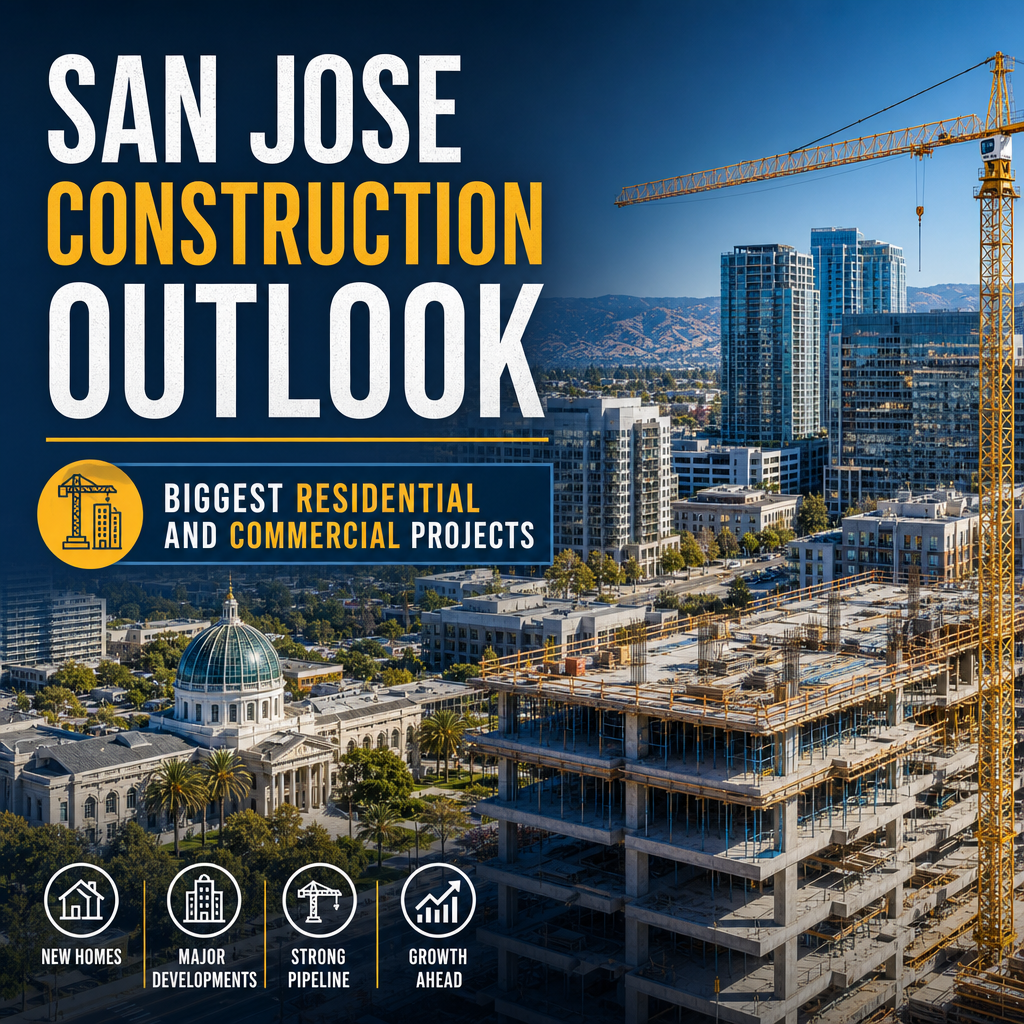
San Jose Construction Outlook: Biggest Residential and Commercial Projects
San Jose Construction Outlook: Where the Biggest Residential and Commercial Projects Are Happening
San Jose remains one of the Bay Area’s most closely watched building markets, even as higher interest rates, shifting office demand, and tighter project financing continue to reshape development plans. The current San Jose construction outlook points to a market that is still active, but more selective.
Instead of growth spreading evenly across the city, the biggest residential and commercial projects are clustering in a few key districts. These are the areas where land, transit access, and long-term planning are aligning to support major construction activity.
Why Construction Is Concentrating in Key Areas
The city’s development pipeline is being driven by a few clear forces:
- Demand for new housing near jobs and transit
- Continued interest in mixed-use urban districts
- Long-term investment around major transportation upgrades
- Commercial construction shifting toward specialized uses rather than traditional office space
That means the strongest activity is happening where zoning, infrastructure, and market demand overlap.
Residential Construction Hotspots
Downtown San Jose
Downtown remains one of the most important areas in the San Jose construction outlook, especially for multifamily housing. High-rise and mid-rise residential projects continue to define the city’s urban growth strategy.
Developers are targeting downtown because it offers:
- Access to transit and walkable amenities
- Proximity to major employers
- Opportunities for mixed-use housing with retail on the ground floor
- Long-term value tied to future transit expansion
Many of the city’s largest planned or active housing projects are concentrated here, particularly in neighborhoods near the core business district and public transit corridors.
Diridon Station Area
The Diridon Station area is one of the most significant long-term development zones in San Jose. It is expected to remain a major magnet for both residential and mixed-use construction because of its regional transit importance.
This part of the city is attractive for large-scale projects due to planned connections to:
- Caltrain
- BART
- ACE
- Light rail
- Future high-capacity transit improvements
Residential projects near Diridon are especially appealing to developers looking to build transit-oriented communities. Even when individual projects move slowly, the area continues to hold strong strategic value.
Berryessa and North San Jose
Berryessa and North San Jose are also seeing notable residential momentum. These areas benefit from larger parcels, easier access to highways, and improving transit connections.
In North San Jose, residential growth is often part of broader mixed-use planning, where housing is added alongside retail, research space, and employment centers. Berryessa has become increasingly important as transit access improves, making it a practical location for denser housing development.
Together, these districts reflect a broader trend: San Jose is pushing more housing into areas that can support long-term population growth without relying entirely on car-dependent expansion.
Where Commercial Projects Are Moving Forward
North San Jose
North San Jose remains one of the city’s strongest commercial construction zones. While the traditional office market has cooled, this district still attracts development tied to advanced manufacturing, research, industrial flex space, and campus-style commercial projects.
Large commercial projects here are more likely to focus on:
- R&D facilities
- Industrial and logistics uses
- Life science or specialized technical space
- Mixed-use business parks
This shift is important. The San Jose construction outlook is no longer centered only on office towers. Commercial construction is becoming more specialized and more closely tied to sectors that still need physical space.
Downtown Commercial Corridors
Downtown commercial development is still active, but it is evolving. New projects are increasingly designed as mixed-use properties that blend office, residential, hotel, and retail components.
Rather than purely office-driven development, the downtown market is leaning toward flexible commercial formats that can adapt to changing demand. Ground-floor retail, entertainment uses, hospitality, and smaller-scale office space are all playing a role in keeping projects viable.
This makes downtown one of the city’s most dynamic commercial submarkets, even if the pace is different from the pre-pandemic development cycle.
Medical, Institutional, and Public Projects
Another major part of the local construction story is institutional development. Healthcare facilities, education-related construction, and public infrastructure projects continue to move forward even when private-sector development slows.
These projects are important because they provide stability in the market and often anchor nearby private investment. In San Jose, institutional work can have a major influence on surrounding residential and commercial growth patterns.
The Rise of Mixed-Use Development
One of the clearest trends in the market is the rise of large mixed-use projects. Developers are increasingly combining housing, retail, office, and public space into a single plan.
This approach works well in San Jose because it helps address multiple needs at once:
- More housing supply
- Better land efficiency
- Stronger walkability
- Reduced dependence on long commutes
- Higher long-term project resilience
In practical terms, many of the city’s biggest projects are no longer purely residential or purely commercial. They are integrated developments built around transit, density, and neighborhood-scale amenities.
What to Watch Next
Looking ahead, the San Jose construction outlook will likely be shaped by a few major factors:
Housing Demand
San Jose still needs more housing, especially in transit-rich locations. That keeps residential construction at the center of the market.
Transit-Oriented Growth
Areas around Diridon, Berryessa, and downtown are likely to remain top priorities because they align with long-term regional transportation goals.
Commercial Adaptation
Commercial development will continue, but mostly in sectors that support research, industrial activity, healthcare, and flexible mixed-use formats.
Final Takeaway
The biggest construction projects in San Jose are not spread evenly across the city. They are concentrated in districts with strong transit access, redevelopment potential, and room for higher-density growth.
Downtown San Jose, the Diridon Station area, North San Jose, and Berryessa stand out as the places to watch most closely. For anyone tracking local development, these neighborhoods offer the clearest picture of where San Jose is building next—and what the future of the city may look like.